Site Selection & Preparation
Choosing the right site is the first critical step in padel court construction. Whether you're adding a single court to an existing facility or building an entire padel club, careful site selection and preparation will set the stage for a successful project.
Key Location Factors
Space Requirements
A regulation padel court requires careful planning for adequate space:
- Standard Court Dimensions: 10m × 20m for the playing area
- Minimum Total Area: 11m × 21m (231 m²) per court including perimeter clearance
- Multiple Courts: Add pathways or seating space between adjacent courts (typically 2-3m)
- Indoor Height Requirements: Minimum 8m ceiling clearance, with 10m recommended for high lobs
- Additional Space: Consider areas for spectators, equipment storage, and amenities
Planning Multiple Courts
For a typical 4-court facility, a minimum land area of approximately 1,000 m² is recommended:
- 4 courts (231 m² each): 924 m²
- Walkways and access: ~100 m²
- Additional clearance: ~50 m²
Single Court Considerations
While most padel is played as doubles on standard 10m × 20m courts, some facilities incorporate single courts:
- Single Court Dimensions: 6m × 20m (compared to 10m × 20m for standard doubles courts)
- Recommended Ratio: Industry standard is approximately 1 single court for every 8 double courts
- Strategic Placement: Single courts should be positioned where they can be easily monitored and accessed
- Space Efficiency: For smaller facilities with limited space, single courts can maximize player capacity
Orientation and Sunlight
Proper orientation is crucial for player comfort and optimal playing conditions:
- Optimal Orientation: North-south along the court's long axis minimizes players looking into the sun during morning or evening play
- Alternative Solutions: If north-south orientation isn't possible, consider incorporating shade structures or windbreak panels
- Wind Protection: Assess prevailing winds and provide natural windbreaks (trees, walls) or transparent screens when necessary
- Lighting Considerations: For courts with artificial lighting, position fixtures to avoid casting shadows or creating glare
Accessibility and Visibility
Location accessibility significantly impacts facility success:
- Access Points: Choose locations with convenient road access and adequate parking
- Visibility: Sites visible from main roads can help attract walk-in clients
- Amenities Space: Ensure adequate space for supporting facilities like clubhouse, restrooms, or spectator seating
- Utility Access: Confirm availability of electricity, water, and drainage infrastructure
- Public Transportation: Consider proximity to public transport options when applicable
Soil and Terrain
Ground conditions significantly affect construction complexity and costs:
- Ideal Terrain: Flat, well-draining sites require minimal earthworks
- Soil Testing: Conduct geotechnical soil tests to determine bearing capacity and water table level
- Problem Soils: Clay or peat soils might need removal or stabilization with gravel
- Rocky Terrain: Provides good support but may require costly excavation for foundations
- Flood Risk: Avoid flood-prone areas unless extensive drainage solutions are planned
Soil Suitability Ratings
- Excellent: Gravel, sandy gravel - Excellent drainage, high stability
- Good: Sand, silty sand - Good drainage, stable with proper compaction
- Fair: Silt, sandy silt - Moderate drainage, may require improved drainage systems
- Poor: Clay, organic soils - Poor drainage, may require significant amendments
Climate Considerations
Rain and Drainage
Effective drainage is essential, especially in high-rainfall regions:
- Surface Slope: Incorporate a slight slope (approximately 1%) for water runoff
- Perimeter Drainage: Install perimeter drains around courts to channel water away
- Porous Sub-base: Use free-draining materials like crushed stone beneath courts
- Drainage Capacity: Design systems to handle local maximum rainfall intensities
Heat and Sunlight
In hot climates, special considerations help mitigate excessive heat:
- Shade Structures: Consider partial roofing or canopies to reduce direct sunlight
- Material Selection: Choose surface materials with lower heat retention properties
- Ventilation: For indoor courts, ensure adequate air circulation and cooling
- Player Amenities: Include shaded waiting areas and water stations
Cold Climate Adaptations
Cold regions require specific adaptations:
- Frost Protection: Ensure foundations extend below the frost line to prevent heaving
- Snow Management: Plan for snow removal and storage areas for outdoor courts
- Indoor Options: Consider enclosed or convertible structures in regions with harsh winters
- Material Durability: Select materials rated for freeze-thaw cycles if applicable
Legal and Zoning Considerations
European Regulations
European countries typically treat padel courts as permanent sports structures:
- Building Permits: Most European jurisdictions require formal building permits or planning permission
- Local Impact: High walls (3-4m) and lighting may trigger additional requirements related to neighbor impacts
- Documentation: Expect to provide detailed site plans, dimensions, and structural specifications
- Noise and Lighting: Some municipalities require noise and lighting studies to ensure compliance with local standards
- Regional Variations: Requirements can vary significantly between different regions, even within the same country
North American Permits
U.S. and Canadian regulations focus on zoning compliance and safety standards:
- Zoning Approval: Ensure land is zoned for recreational use or obtain necessary variances
- Building Codes: Comply with local building codes for structural safety (foundation, wind loads)
- Accessibility: Meet accessibility laws (e.g., ADA in the U.S. requires wheelchair access)
- Community Feedback: Some projects may require notifying neighbors or attending public hearings
- Additional Permits: Commercial facilities may need permits for electrical work, occupancy, etc.
Asian Standards
Regulations across Asia-Pacific vary widely:
- Established Markets: Regions with strong padel presence (Middle East, Japan) have specific permit requirements
- Emerging Markets: In areas where padel is newer, general building codes apply but sport-specific rules might be limited
- Urban Solutions: Densely populated cities may require innovative approaches (e.g., rooftop courts) with special structural approval
- Classification: Some countries classify unroofed padel courts as temporary structures, potentially simplifying permits
- Local Expertise: Working with local architects or consultants familiar with local regulations is highly recommended
Site Preparation Steps
Clearing and Leveling
Proper ground preparation creates a stable foundation:
- Vegetation Removal: Clear all vegetation, rocks, and existing structures from the court footprint
- Precision Leveling: Use laser leveling equipment to achieve a near-perfect flat surface
- Earth Moving: Utilize excavators and bulldozers to cut high spots and fill low areas
- Soil Compaction: Thoroughly compact the soil to create a stable sub-grade
- Quality Control: Even small bumps or dips can affect the final court surface quality
Marking and Excavation
Precise marking ensures proper construction:
- Court Outline: Survey and mark the exact court dimensions and foundation locations
- Foundation Trenches: Excavate trenches for concrete foundations around the perimeter
- Depth Requirements: Typical strip footings require excavation of 0.5-1m depth
- Utility Preparation: Excavate additional areas for drainage lines or electrical conduits
- Full Slab Option: For slab foundations, excavate the entire court area to the required depth
Court Measurements and Foundation Planning
Understanding the precise dimensions and foundation requirements is crucial for proper site preparation. The court itself measures 20×10 meters, but the foundation must be larger to accommodate structural requirements and lighting infrastructure.
Foundation Specifications
- Court Dimensions: 20m × 10m playing surface
- Foundation Size: Minimum 21m × 11m (231m² total area)
- Reinforced Concrete Layer: 16cm thick with Ø12mm rebar at 20cm intervals
- Gravel Layer: 15-20cm thick for drainage and stability
- Natural Terrain: Compacted base layer
- Perimeter Curb: 40cm × 40cm reinforced concrete perimeter
The foundation design must also accommodate lighting infrastructure. Light tubes will be positioned 5 meters from the center of the court, integrated within the foundation structure to provide optimal court illumination.
Court Foundation Plan View
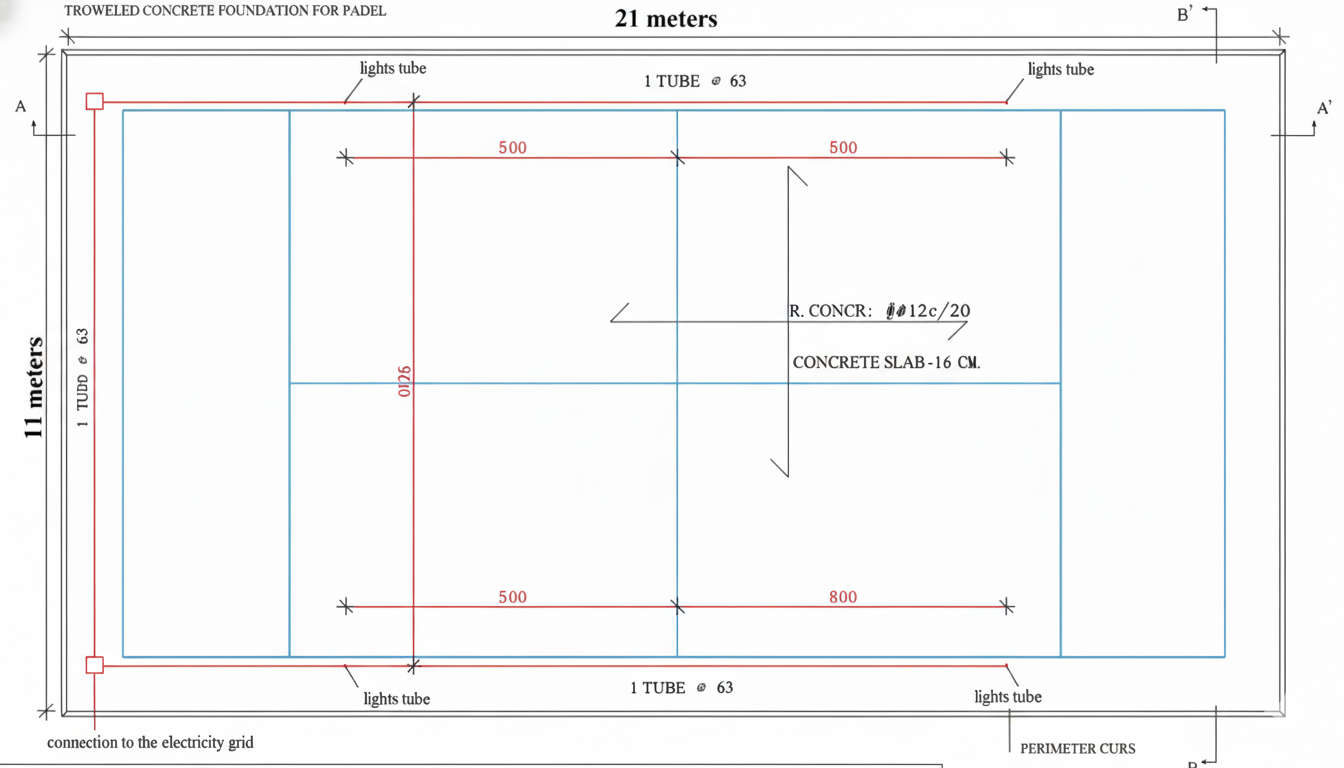
Foundation plan showing the 21×11m foundation area with integrated lighting tube positions
Detailed Court Measurements
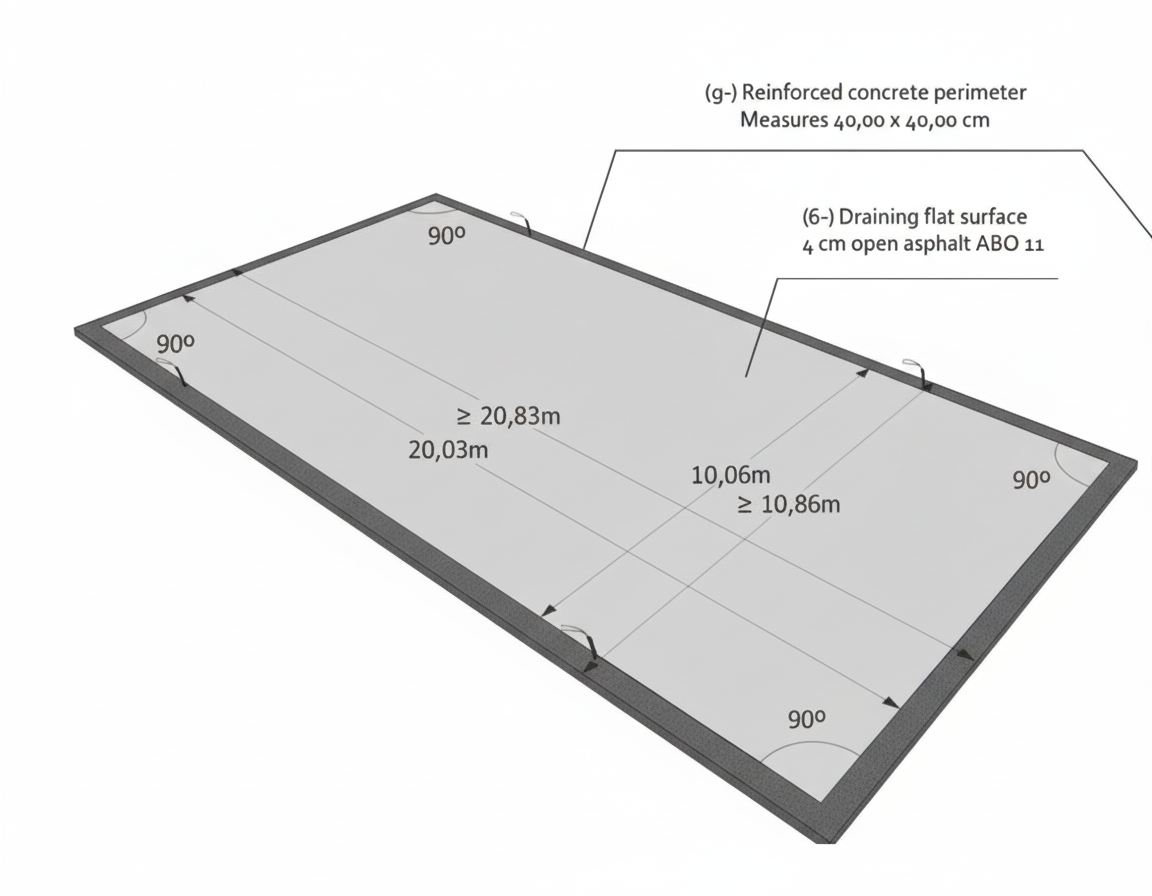
Detailed measurements showing court dimensions, foundation size, and lighting tube placement at 5m from center
Foundation Cross-Section (Section A-A')
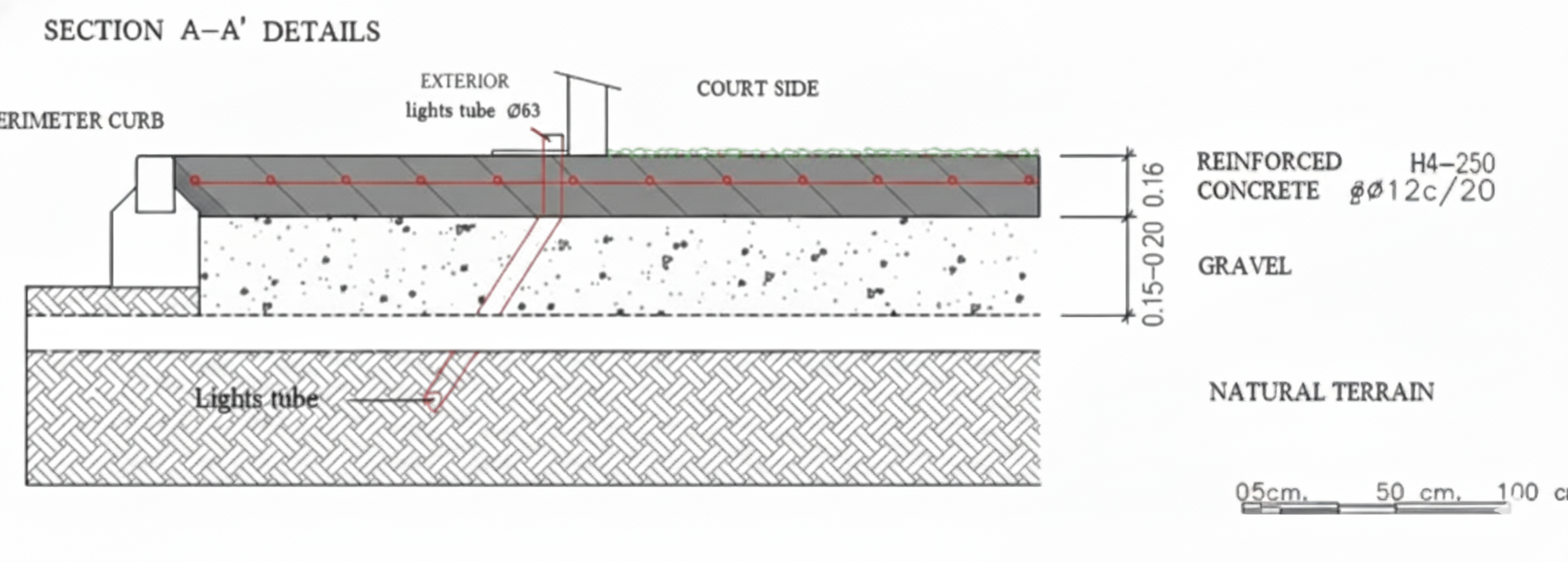
Cross-section showing the layered foundation structure with 16cm reinforced concrete, 15-20cm gravel layer, and natural terrain base
Sub-base Installation
The sub-base provides drainage and stability:
- Material Selection: Typically use crushed stone or gravel for drainage and stability
- Layer Thickness: UK guidelines recommend a 250mm layer of free-draining aggregate
- Installation Process: Truck in graded stone, spread in layers, and compact each layer firmly
- Drainage Integration: Install drain pipes (e.g., French drains) around the perimeter
- Final Grading: Grade to the desired slight slope (typically 1% or 1:100) for water flow
- Utility Integration: Lay conduits for electrical wiring or plumbing at this stage
Sub-base Layer Structure
- Bottom Layer: 100-150mm coarse aggregate (40-75mm stone)
- Middle Layer: 100mm medium aggregate (20-40mm stone)
- Top Layer: 50mm fine aggregate (5-20mm stone)
- Final Layer: Thin layer of coarse sand for leveling